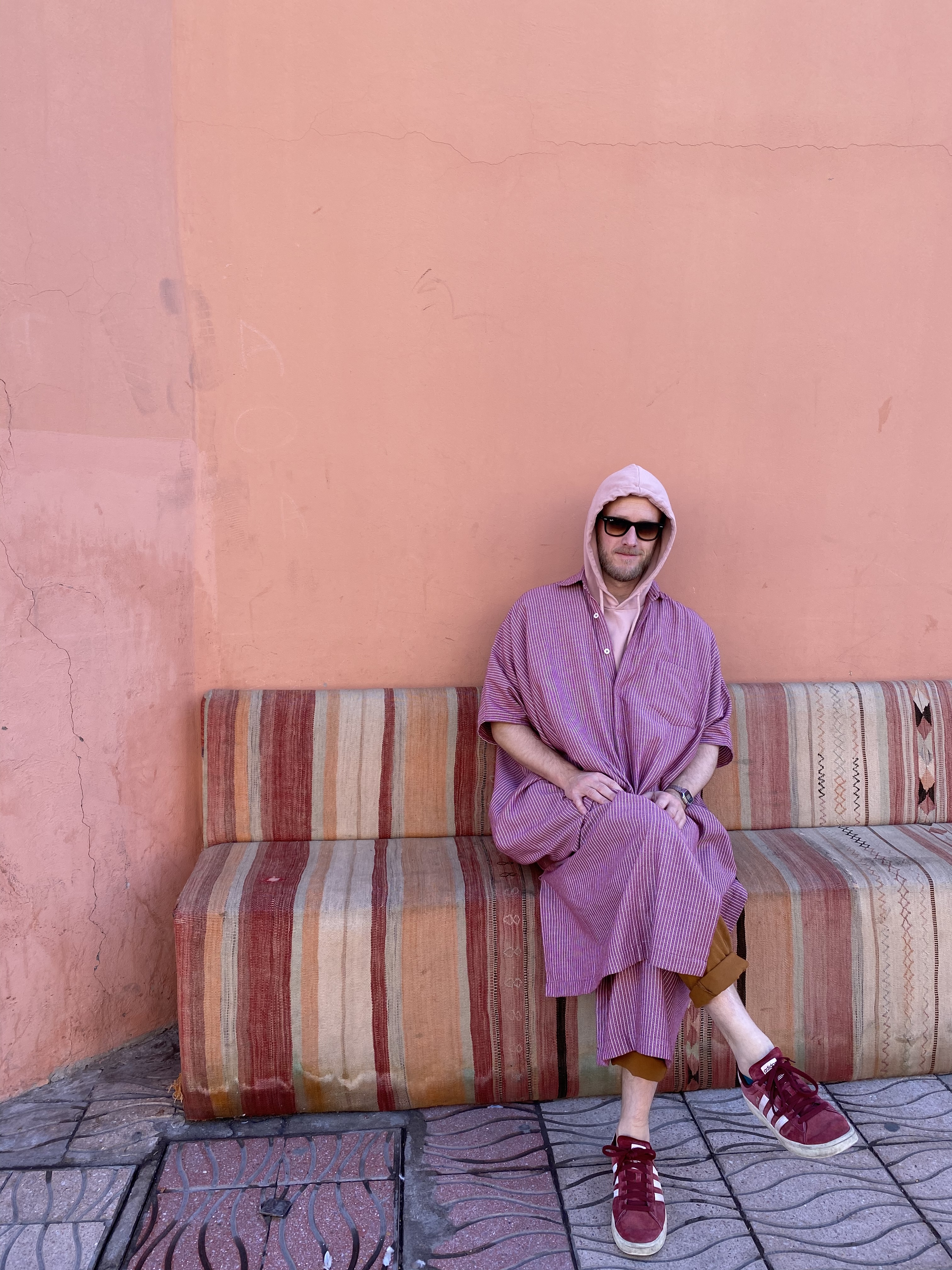
The bag was gone. Not delayed, not misrouted — gone, in the frank and definitive way that certain things go missing in Marrakech. The airline used a word like “inconvenience.” I used other words, privately, then walked into the medina and bought a djellaba.
It was ivory linen, too long by half, and cost less than a glass of wine in Geneva. I wore it back to El Fenn with a kind of resigned dignity, and Coco, who had been waiting with mint tea at a low table near the courtyard fountain, looked up and laughed for approximately four minutes.
“You actually look completely right,” she said, once she had recovered herself. I chose to take this as a compliment.
 El Fenn — Marrakech
A Djellaba & a Lesson
There is something El Fenn does to you almost immediately, which is to make the things you were previously concerned about seem considerably less important. Lost luggage, a delayed flight, the precise location of your laptop charger — the hotel absorbs these anxieties the way thick walls absorb heat. You arrive stressed. You are, within the hour, measurably less stressed.
This is partly architecture, partly the quality of the light at a particular hour, and partly something more difficult to name. El Fenn was built on a specific set of values — art, beauty, a certain anti-establishment instinct — and those values are still, two decades on, present in every corner of the place.
My djellaba, it should be recorded, hung perfectly in the morning air.
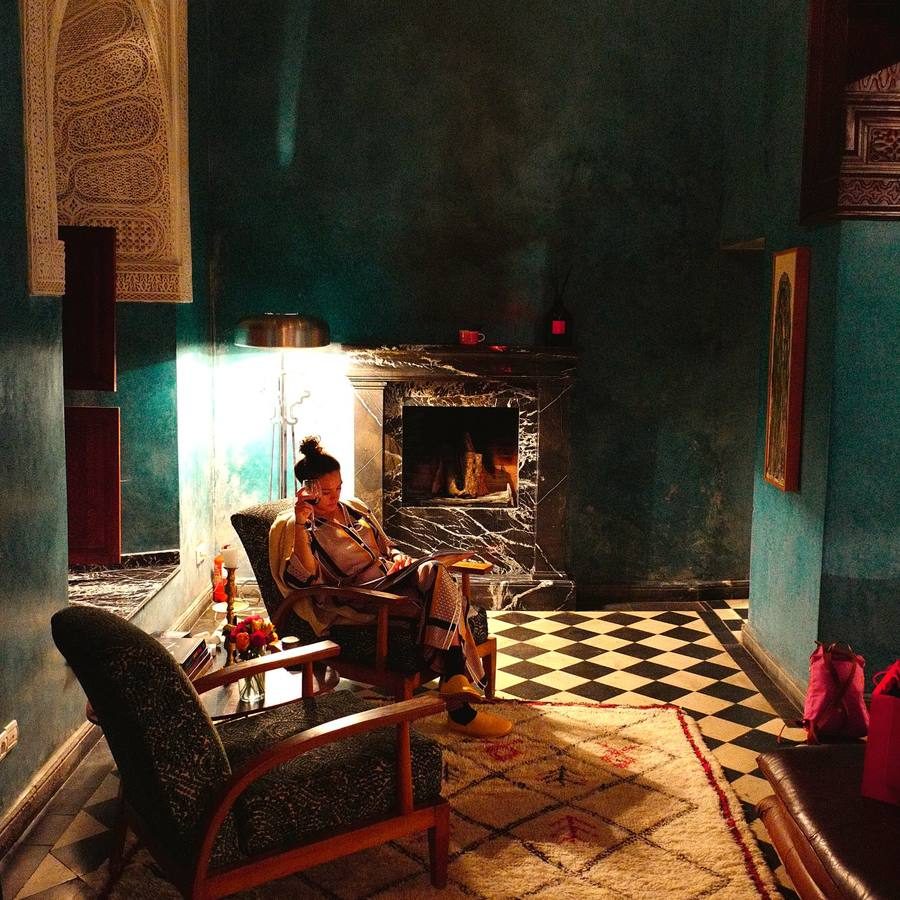 The Salon — El Fenn
The Door That Reveals Nothing
The entrance to El Fenn is a study in deliberate concealment. Worn wood, an eye-level peephole, a wall the colour of old terracotta. Nothing announces itself. You knock — or ring, or simply push — and then the door opens, and the medina roar drops to a murmur, and you step into a brûlée of deep red and an indoor sky of painted plaster.
Vanessa Branson and Howell James bought number 2 in the early 2000s. Then they bought numbers 3, 4, 5, and 6. The hotel expanded room by room, courtyard by courtyard, becoming something that could not have been planned — only accumulated, over time, by two people who trusted their instincts entirely.
In 2025, ownership passed to the Akan group and the Benabbès-Taarji family. The soul — the art, the instinct, the belief that a hotel can hold a point of view — remained.
%20MOGGI%20PHOTOGRAPHY%20-%20Koutoubia%20Terrace.jpeg) The Koutoubia Terrace — El Fenn
The Koutoubia Terrace — El Fenn
Tea on the Rooftop
The rooftop at El Fenn is not a view. It is a position. From here, the Koutoubia minaret appears to your left, the Atlas mountains to the south, and the medina sprawls below in every other direction — a terracotta sea interrupted by satellite dishes and the occasional palm.
They bring mint tea in a silver pot. The glass is too hot to hold comfortably, which is correct and proper. You drink it anyway, standing at the parapet, watching the light change over the mountains.
I stood there long enough that Coco came to find me. We did not speak for a while. Some views do that — they reduce conversation to its essential minimum, which is silence accompanied by good company.
“To stay at El Fenn is to stay somewhere that came into being through love — not capital. That is the distinct and unmistakable difference.”
%20MOGGI%20PHOTOGRAPHY%20-%20Luxury%20with%20Authenticity.jpeg) The Restaurant — El Fenn
The Restaurant — El Fenn
The Souks & the Silence Inside
Jemaa el-Fna at dusk is a calculated assault on every sense simultaneously. Smoke, drums, teeth being sold from a cloth, a man with a cobra, the smell of merguez. You stay for twenty minutes, maybe thirty, before the body votes to withdraw.
The walk back to El Fenn takes ten minutes through the souks — copper, leather, saffron, noise — and then you push the worn door and it is quiet. Antony Gormley’s ink drawings watch from the walls. A Francis Upritchard chandelier does something extraordinary with the light. These are not decorations; they are arguments, made in the language of objects, about what this place believes in.
El Fenn co-founded the Marrakech Biennale in 2005. The art here has always been the point.
I retrieved the bag, eventually. It arrived on the third day, slightly worse for its adventure. By then I had worn the djellaba to dinner, to a walk through the Mellah, and to a long lunch on the rooftop where the Atlas mountains were doing something exceptional with the clouds.
I left it, folded, on the chair by the window. It seemed right to leave something behind.
— Mr. Kim
In a white Moroccan djellaba
El Fenn, Marrakech
A Velour Pick